
Specialized Storage and Services for Fine Art, Design, Collectibles and Furniture

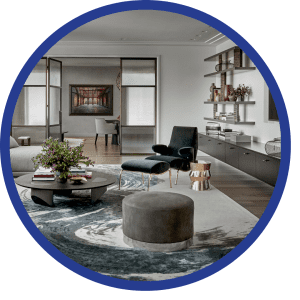
As Art Basel and Design Miami open their doors this week, collectors and designers converge on South Florida—not only to discover exceptional works, but to acquire pieces that will eventually shape extraordinary interiors. But between the moment a collector falls in love with a piece on the fair floor and the day it’s perfectly installed in their home lies a complex web of logistics that most never see.
We spoke with Steve Kadlec, Principal at Kadlec Design, and Sarah Johnson Court, Vice President at Risk Strategies, to explore what it takes to bring luxury design visions to life—from acquisition through installation—and how strategic partnerships ensure every detail is executed flawlessly.
For Kadlec, whose Chicago-based studio has spent over 20 years creating interiors from Miami to Los Angeles, the definition of “design” extends far beyond aesthetics. “Interior design encompasses planning, design, budgeting and scheduling related to interior construction and furnishings,” he explains. “Depending on the scope of the project, different aspects of interior design are required.”
This comprehensive approach begins with understanding what clients already own. “We start with understanding a client’s existing art collection as well as other fine art objects before starting the design process,” Kadlec notes. “Working with existing conditions, both architectural and art/furnishings, is an important part of developing an appropriate design solution.”
When it comes to Miami specifically, Kadlec observes a distinct creative energy: “Design projects in Miami are more open to experimentation and the climate and culture invites more color and artfulness.” This openness extends to the designers and makers he follows. “Jiun Ho furniture based in San Francisco is innovative and focused on craftsmanship and regional design inspiration. Refractory Studio is a Chicago-based design studio featuring cast bronze and glass furniture, lighting and art objects that speak to materiality and handmade fabrication. Steven Haulenbeek is a Michigan artist who experiments with cast bronze and other materials in the creation of highly unique custom furniture and sculpture.”
But inspiration alone doesn’t execute a large scale high end residential project. For that, Kadlec emphasizes the critical importance of logistics partnerships: “Our residential projects in all markets require the best shipping, receiving and delivery service to ensure our client’s investments are preserved and project schedules are maintained.”
Johnson Court, whose 20-year career as a Lloyd’s of London trained Fine Art broker has given her insight into what can go wrong—and how to prevent it—sees the scope of collections expanding far beyond traditional categories.
“Understanding the client and their collection is crucial, so I always ask a lot of questions, especially as collections can include many things outside of what is typically considered ‘fine art,'” she explains. “For example, collectible design, collector cars, wine/whisky, sports memorabilia, coins, stamps—these can all be insured together on a fine art policy with a specialist insurer and broker who understand the nature of these collections and how to manage and settle nuanced claims.”
The devil, as always, is in the details. “From an insurance perspective, it is pretty broadly defined—’objects of art of every nature and description’—so it’s really up to us brokers to paint a picture for insurers on the unique qualities, craftsmanship, value and provenance that makes something insurable as art or design. Generally higher valued objects, unique or limited edition pieces and custom objects can be considered ‘art.’ How you then insure them, on a blanket limit or on a scheduled and agreed value basis, is something to discuss in detail with your broker.”
When it comes to transit—the moment of highest risk—Johnson Court’s due diligence is exhaustive: “We always do our due diligence on a shipper before presenting them to a client’s insurer. This includes details of the trucks and ensuring they are air-ride, climate controlled, GPS tracked and that there will always be at least two drivers, so the truck is never left unattended during shipment. For storage we also require a facilities report of their locations and often do site-visits to familiarize ourselves.”
But perhaps most critically: “We also always recommend condition reports, as these are the key documents that are referred to immediately when there is loss or damage. These should be done on both ends of any shipment and saved for reference.”
This is where Fortress enters—providing the specialized infrastructure that makes designers’ visions and insurers’ requirements a reality.
In February 2023, a nationally recognized interior designer approached Fortress with an extraordinary challenge: receive, store, and eventually install 250+ luxury furnishings for a 27,000-square-foot Palm Beach estate—all in pristine, all-white and cream finishes—across a 13-month timeline during new construction.
The project required receiving 250+ pieces from vendors including The Invisible Collection, Holly Hunt, Christian Liaigre, and Roll & Hill—often multiple shipments arriving on the same day. Each piece underwent comprehensive condition inspection with photographic documentation uploaded to the design team’s Dropbox within 24 hours. Weekly inventory updates kept the designer informed throughout the entire 13-month timeline.
This aligns precisely with Johnson Court’s insurance requirements: “Condition reports are the key documents that are referred to immediately when there is loss or damage.” Fortress’s documentation system creates that paper trail from the moment a piece arrives.
During the 13-month receiving period, the Palm Beach project occupied 13 separate climate-controlled vaults totaling 1,800 square feet. Unlike facilities that co-mingle items from different projects, Fortress provides complete separation for each designer’s inventory—ensuring that all clients’ items stay together and access control maintained.
For a project with an all-white and cream palette, this proved essential. “The homeowner was very particular,” recalls the Fortress team. “Everything had to remain pristine from arrival through final installation. If we discovered any marks during inspection, we notified the designer immediately so she could arrange for a replacement.”
Kadlec confirms this approach makes all the difference: “For projects with long timelines, we try to manage order placement to reduce excessive storage needs when possible, but having a trusted and quality local company to help manage changing schedules is critical. The differences between standard warehouse and white-glove service are dramatic—all high-end design projects require white-glove service to facilitate a smooth process, troubleshoot and solve logistical challenges, and protect art and furniture throughout the entire process.”
Kadlec’s process emphasizes involving logistics partners before orders are even placed: “We typically engage with our logistics partners prior to ordering furniture. For buildings with challenging entries, elevators and hallways, we review the conditions on site with our logistics partners and strategize together on implementing a successful furniture installation. Doing this ahead of time allows us to make adjustments to custom furniture pieces prior to fabrication when sizing may cause installation challenges.”
For the Palm Beach estate, when construction completed ahead of schedule in March 2024, Fortress mobilized a six-person installation team for an eight-day placement process. Enormous factory-rolled rugs required specialty vendors. Oversized travertine furniture pieces couldn’t be moved with equipment inside the home. The grand foyer became a staging area for systematic unpacking, inspection, and room-by-room installation.
Throughout the eight days, teams wore booties, gloves, and full arm sleeves to protect fabrics. Two trucks delivered daily, maintaining coordination with the designer who directed final placement. The clients walked into a completely finished residence—all the complexity handled before they crossed the threshold.
This week, as collectors move through Design Miami and Art Basel, these three perspectives intersect.
Johnson Court, who worked at Design Miami before joining Risk Strategies, describes why the fair remains exceptional: “Even before working for Design Miami, people always told me it is their favorite fair, and that continues to be true for myself and many others today. The time, creativity, detail, and cost that the galleries and partners put into creating one-of-a-kind temporal spaces that only exist for a matter of days is unlike any other fair. The environment created for these beautiful and unique pieces is a transformative and whimsical escape from the norm, not to mention that many of the contemporary artists are often at the fair and eager to meet collectors and share stories about their work and process.”
Her philosophy on collecting emphasizes passion over profit: “While some people may collect for investment purposes over aesthetics, the best collections are generally put together by those who have a deep love for what they collect and are eager to learn and interact with galleries, artists, designers and attend as many fairs and events as possible.”
But fair acquisitions require immediate planning. Johnson Court cautions: “From an insurance perspective, the key is to not assume a homeowner’s policy will adequately cover design pieces. There are often sub-limits per item and high deductibles versus specialty art insurance, which often has no deductible and can be insured on an agreed/scheduled value basis.”
For pieces acquired during Art Week, Fortress provides immediate receiving, secure storage in private climate-controlled vaults, and coordination with international shippers—managing customs, transit logistics, and final delivery when pieces are ready for placement.
Johnson Court’s guidance extends beyond acquisition and transit to the ongoing protection of installed collections: “Risk mitigation is key, especially in areas with severe weather conditions. We offer guidance around UV protection on windows, monitoring of humidity, placement of pieces that are prone to fading being in darker areas, to more complex risks such as outdoor sculptures with in-situ crating.”
Proactive planning proves essential: “We also urge clients to arrange emergency plans with their local fine art shippers, who would then remove the collection, or the pre-agreed top items, to their secure storage locations ahead of a major event. All too often we get calls once a hurricane is about to hit land and everyone is calling in favors to try and get their collection relocated—this is where proactivity and planning really ensure peace of mind for all.”
Creating extraordinary interiors requires designers who understand their clients’ visions, insurance professionals who protect every investment, and logistics partners who execute flawlessly.
After 40+ years serving collectors, institutions, and the design trade, Fortress has built systems that support the most complex residential projects while maintaining museum-level care for every piece. Our purpose-built, stand-alone facilities in Boston and Miami provide private climate-controlled vaults, real-time inventory systems, and white-glove installation teams trained in fine art handling.
As Kadlec summarizes: “Our residential projects in all markets require the best shipping, receiving and delivery service to ensure our client’s investments are preserved and project schedules are maintained.”
That collaborative standard—where design vision, risk management, and logistical excellence align—is what transforms acquisitions into installed realities.

Stephen J Kadlec is Principal of Kadlec Design, a Chicago-based studio with over 35 years of experience in residential interior architecture. His work has been featured in Architectural Digest, Luxe Magazine, and House Beautiful. The studio’s projects extend across the country including Los Angeles, Palm Desert, Austin, Miami, Naples,Connecticut, and Michigan. www.kadlecdesign.com

Sarah Johnson Court is Vice President at Risk Strategies, specializing in fine art and high-net-worth insurance. With over 20 years of industry experience as a Lloyd’s of London trained Fine Art broker, she serves collectors, museums, galleries, artists, and foundations. She holds a Master’s degree in Art History from Richmond, the American International University in London. She serves on the Leadership Committee for the Bass Museum’s Women’s Circle and her local Art & Culture advisory board in Biscayne Park, Miami. https://www.risk-strategies.com/
